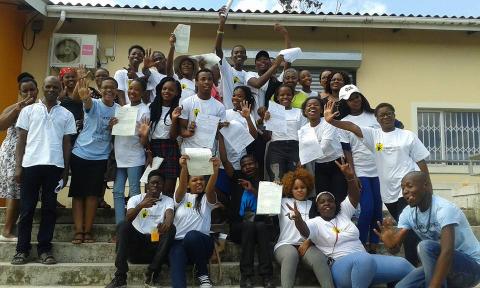
In January this year, we were super excited to announce that our matric class of 2015 had achieved a staggering 80% pass rate, beating the national average by 9%. Passing matric, however, is only the first hurdle that South African youth need to clear, in order to set themselves on the path towards earning a dignified living. IkamvaYouth strives to ensure that our learners access post school opportunities in the form of tertiary studies, learnerships/other apprenticeship programmes, and employment. IkamvaYouth are pleased to report an overall 90% placement rate for our class of 2015, an increase from last year’s 85%!
56% of the learners who passed are now pursuing tertiary studies, enrolled in a wide range of courses this year. The fields of study being pursued the most this year are science & engineering, with an impressive 25% of the cohort pursuing qualifications in these areas, followed by a close 19% of the learners enrolled in commercial studies. Other courses being pursued by our class of 2016 include Psychology, Legal studies, Nursing, Maritime studies, and Media/Marketing related studies.
After the excitement of passing matric, and then getting accepted into tertiary, our learners have to contend with yet another hurdle: accessing funds to finance their studies. While we are concerned about the high number of learners who have not yet secured funding for their studies this year, we are really pleased that most (57%) have secured funding through study loans (mostly through NSFAS: 43%) and bursaries/scholarships. We are particularly proud of these Ikamvanites who managed to secure bursaries/scholarships:
-
Palesa Machabela from the Ebony Park branch received a university entrance bursary to study Human Life Sciences at the University of Stellenbosch.
-
Thabang Rankeng, also from Ebony Park was awarded by the Gauteng City Region Academy, for being among the top three performing learners in his school. He is now studying towards a BSc (Chemistry) degree at Wits.
-
Chumisa Yapi from Makhaza was awarded a university entrance bursary by UCT, to study towards a BSc degree.
-
6 learners were awarded the prestigious Moshal Scholarship: Wandile Majozi and Nhlanhla Mabaso from Chesterville, both studying towards Bcom (accounting) degrees at UKZN; as well as 4 learners from Ebony Park: Puledi Chipape (Geological Sciences at Wits), Kefilwe Maake (Mechanical Engineering at UCT), Sharon Maota (Biological Sciences at Wits), and Onkarabile Kau (Computer Science at the University of Pretoria).
Here’s what 2 of the bursary recipients had to say:
“Ikamva has taught me the reward of focus and preparation especially when it comes to post matric preparation. Honestly without IkamvaYouth I would not have been heading into the bright future I am heading into today (Going to Stellenbosch University, my parents not having to pay for my fees)” – Palesa Machabela
“I feel very happy and blessed that the Moshal program granted me this scholarship. I really feel special and thank the program for believing in me and giving me this opportunity to further my studies. … Receiving the scholarship means … the world to me… it showed me that some people out there believe in me and have faith that I can do wonders in this field.” – Puledi Chipape
Congrats on getting your feet through the door towards a brighter future, Ikamvanites! We are so proud of what you’ve achieved so far, and are so looking forward to seeing you realise your dreams.
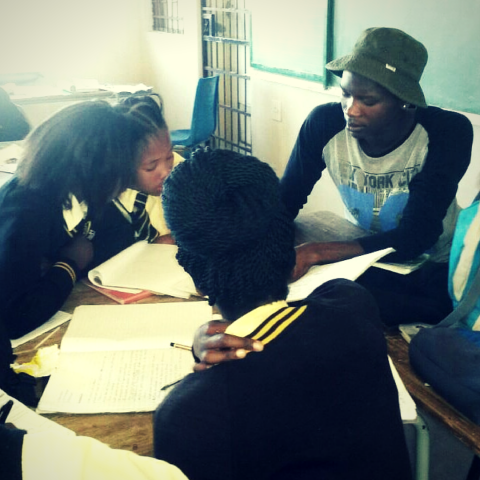
There is a popular African proverb that says “it takes a village to raise a child”. Nowhere is this proverb more important than in the education of our children. The success of the child depends on the community that surrounds and supports them. That community is made up of staff, learners, tutors, volunteers and parents.
Two of the volunteers at the Joza branch share some of their thoughts on why they continue paying it forward and volunteering at the branch. Sibulele Moyakhe is from the matric class of 2015. He tutors daily at the branch while waiting to start his nursing qualification with Netcare. Nomboniso Gongqa is a volunteer from the community who works in the office in the mornings and tutors in the afternoons.
Being a tutor for me is exciting because I get to meet people of my age and those younger than me and actually help them with their school work. Part of the reason why this whole experience excites me is because in the past few years I was a learner and there were volunteers who helped me with my school work and today I can proudly say they have made a difference in my life which is why today I made a decision to give back to the community and help when I can.
For me this tutoring thing is now becoming my hobby because it is something I get to do every day and I must say I enjoy it. There is nothing quite like being called up by a student who is stuck or cannot solve a problem asking for help, and after your assistance you see the smile on their face because you have made a difference in their lives.
One thing I have learnt ever since I have been part of IkamvaYouth is that all it takes to make a difference in one’s life as a tutor is a simple input and help where you can, and that’s what I have been doing.
The learners I work with have been very appreciative which is what drives me to keep on doing what I do, and so far the journey for me has been more than worth it, and yet this is only the beginning.
Sibulele Moyakhe, Matric 2015, Tutor 2016.
Being at IkamvaYouth has been a great experience for me because waking up to go volunteer has made me feel like a better person. Knowing that I am not here to make money for already rich people but rather helping the children of my own community. I was born and bred in Joza and I enjoy being part of an organization that has a motive of helping Joza children to be successful in life.
For me it is exciting every morning when I come to the office to see the children who are willing to put in the hours to benefit their future. The programme gives these children an opportunity to improve their education rather than spend their hours after school being involved in activities such as crime and drugs. They say if one wants to make a change then they should start at home. I’m also gladly starting at home. As much as the learners are learning from me, I am learning from them too.
Nomboniso Gongqa, Volunteer and Tutor.
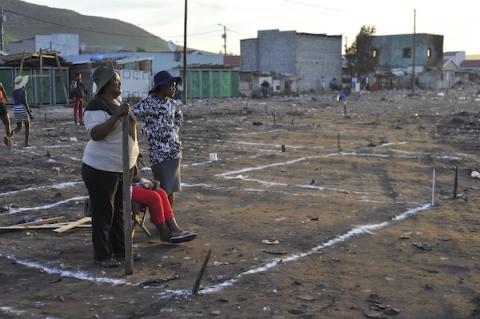
Last December (2015), the Masiphumelele community suffered another fire that left many people destitute.
Three months later, the inhabitants are still feeling the effects and are trying to rebuild their lives. You can read more about the after-effects here: http://www.brightcontinent.co.za/2015/12/06/masiphumelele-fire-township-cape-town/
Nicholas Commeignes (Branch Coordinator – Masiphumelele) has been collecting contributions of furniture, clothing and kitchen equipment for the affected learners and organisations such as State Street and Cognia Law have been contributing. Some funds were reserved to assist the learners to acquire school uniform and stationery at the beginning of the year; their living situations still remain difficult though as some have had to rely on family and friends for accomodation which is sometimes far from their schools. One learner gets home from school at 8pm because of the long commute.
If you would like to contribute towards this fire relief initiative, this inludes items along the lines of clothing (including uniform), stationery, furniture or kitchen equipment, please send an email to nicolas@ikamvayouth.org / hetile@ikamvayouth.org for detailed information on the learners current requirements.

“What counts in life is not the mere fact that we have lived. It is what difference we have made to the lives of others that will determine the significance of life we lead”-Walter Sisulu
Often as human beings we care the most about being judged and praised by what we have accumulated for ourselves; IkamvaYouth KZN tends to differ as we believe we need to be judged by the footprints we leave behind as we go forward.
It is heart-warming to see learners getting excited, feeling valued and mostly recognising the efforts and support from the team in making sure that they remain, succeed and excel in school and in life as a whole. The excitement in their faces and confidence in talking about IkamvaYouth and its benefits gives the IYKZN team courage to keep on keeping-on and positively impacting the lives of learners and the general communities we exist within.
IkamvaYouth solely exists with one big aim and that is to ‘help learners to pass, progress and achieve their dreams in life’. IYKZN is undoubtedly carrying that mission as well, to make a difference to the lives of our learners, tutors and all those who forms part of this organisation.
There is nothing that makes the IYKZN family as happy as reaching the office in the morning to find such a lovely note from one of the learners… One thing that comes first is a smile and then the thought of how just a little amount of effort can go a long way.
As we are reaching the end of term 1 of 2016, IYKZN is still carrying forward the objective of making more of a difference, more positive impact and importantly igniting the spark within our learners…
Here’s to making a difference….!!!!
Alex and I have been attending the Education NGO Leadership Summit in Benoni today, hosted by the National Education Collaboration Trust (NECT).
Godwin Khosa (NECT’s CEO) explained the reasons behind NECT’s focus on interventions at the district level; he said that ultimately, we need to focus on interventions that hold potential for changing the system as a whole. Hence, they are not focusing on the level of the learner, or at that of the school. He said that while NECT could hold Saturday classes and see increased improvement in Maths and Science, these initiatives take a lot of effort, are not systemic, and have a lower sustainability potential.
And I agree with him, in that it’s clear that the system needs an overhaul, with the functionality of schools, districts and provinces increasing dramatically. However, I’m really concerned about the idea that working at the “learner level” is seen as too much effort, unsustainable, and not systemic.
We all know that the learners currently enrolled in the system are in dire need of remedial support to overcome the deficits in their grasp of the basic fundamentals, especially with regard to literacy and numeracy. 27% of our grade 6 learners are functionally illiterate (SACMEQ, 2007), grade 9s scored an average 14% in Maths in the ANAs (2014), and only 3% scored more than 50%. In 2015, the matric pass rate was 71%, but due to heavy grade dropouts, the cohort pass rate was actually just 41%.
Khosa outlined the achievements of NECT to date. While there were some references to “evidence of improvement in the organisation of schools,” the achievements were primarily limited to a list of outputs (number of principals and HODs trained, number of resource packs availed, flash cards, management trackers, etc.) rather than outcomes. Now, while Khosa is absolutely correct that expecting to see improved learner outcomes from NECT in this early stage of its operations (just two years), I am unconvinced that this approach is sufficient for ensuring that 90% of learners pass Maths, Science and Language at above 50% level by 2030 (NECT’s very important and compelling overall objective).
As I outlined in the interview with Business Day a few weeks ago, learners’ gaps in understanding and comprehension, particularly when it comes to STEM and language subjects, require individual attention and personalized learning experiences. And while ICT provides some opportunity for offering personalised and responsive learning experiences at scale, all ed-tech people will tell you, the tech is only ever going to be a small part of what it takes to improve learner achievement.
Learners need relationships, with people who give them time, who build their trust, who help them to figure out where their gaps and challenges are, and then provide them with the academic and psycho-social support they need to dramatically improve their results and confidence. In some homes (mostly in middle class homes), parents and caregivers have the education and time to do this. Most middle class families also enroll children in after-school tutoring programmes.
Unfortunately, this additional support is unavailable to the majority of our country’s learners. It is unrealistic to expect that the education system can provide this level of individualized support to learners, especially when we consider the psycho-social challenges that learners in the lowest quintiles are up against. But the view that doing so is too difficult will ensure the perpetuation of our learners’ dismal academic performance. How can we produce outcomes at the learner level, without working with learners?
Lynn van der Elst, from Miet, said that we need to better understand Government, to put ourselves in their shoes and try understand why things work the way they do. And I think that this important point speaks to the impetus behind NECT’s decision to focus at the district level and above, as levers that make sense for systemic interventions. Government’s job is to serve the 12 million learners who are supposed to be enrolled in the system. Just providing learning materials to 12 million learners must be a colossal challenge, and so it’s unsurprising that the provision of textbooks and digital learning resources is hailed as a systemic intervention, despite the lack of empirical evidence that this will lead to improved academic achievement.
Speakers also spoke about the role of NGOs as innovators, and called for increased collaboration and stronger networks of support. The National Development Plan highlights active citizenry as one of its core pillars, and most of the speakers identified the promotion and creation of active citizenry as a key role for civil society. It is these active citizens that can step up and provide the intense level of support and care that learners need, so that we can see the kinds of radical shifts in academic achievement so desperately needed.
IkamvaYouth’s volunteer tutors and mentors are evidence of what’s possible when citizens become active. Most of these volunteers are university students, and many used to be learners in the programme themselves. By consistently showing up to meet learners where they’re at, they effectively assist learners to dramatically improve their academic results, and go on to access tertiary education, learnerships or jobs. We’re working with almost 20 other tutoring and mentoring programmes, towards achieving collective impact, and together, we will be reaching 3000 learners this year.
Deputy Minister Mr Enver Surty challenged us about the tiny size of our interventions, and encouraged us to think big. “How do we take the principles and vision of the NDP into practical reality?” There were many NGOs in the room who are indeed promoting, inculcating and coordinating active citizens. NGOs like Enke, Fundza, TEACH South Africa, Room to Read, WESSA, Partners for Possibility, Equal Education, Bridge, Section 27 and Breadline Africa. NGOs who are inspiring, recruiting, equipping and coordinating active citizens to roll up their sleeves and get involved in educating learners, providing a pipeline of educators, supporting principals, improving schools, challenging policymakers, and ultimately working towards the NDP’s big goals. While many are working together already, there is always room to better leverage the potential of collaboration. And it is only through collaboration that we’ll be able to operate at the scale that makes sense to Government.
The meeting began with a screening of Thandi’s story, which so smartly illustrates the challenges that the NDP aims to address and overcome. When Trevor Manual spoke at IkamvaYouth’s ten year birthday bash, we screened Funeka’s story, to illustrate the impact that after-school tutoring and career guidance mentoring can have. A meaningful way to contribute towards the NDP’s implementation for civil society is to mobilise and activate citizens, and to coordinate our efforts, with each other, and with Government, so that together we can reach more learners like Thandi and enable them to leverage education and improve their lives, just like Funeka.
We appreciate NECT’s efforts to bring us together, and are looking forward to future engagements. Thank you for this opportunity, which we hope is just the beginning of a more cohesive and collaborative approach to realising the NDP.

 Lloyd Lungu