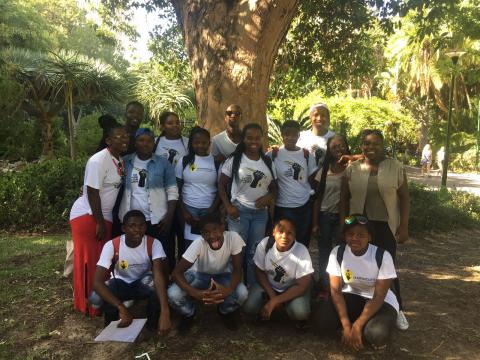
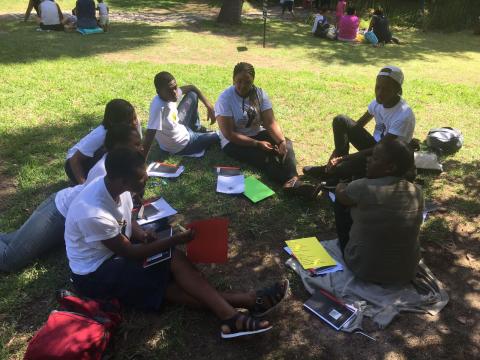
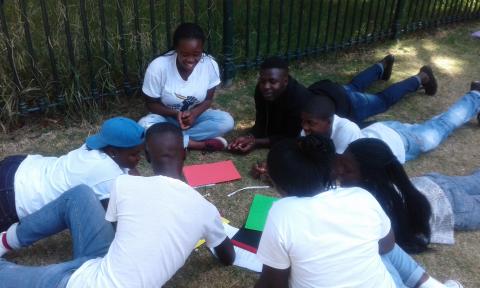
On Saturday the 11th of March, the Nyanga branch had a strategic planning day. The aim of this day was to plan for the year. The event was attended by the newly elected and eager Branch Committee. The group of learners, tutors and staff travelled to the Cape Town Company’s Gardens for the day. The idea was to have a relaxed picnic-style planning day out in the sun.
In true Ikamvanite style, the day started off with an ice-breaker. The agenda for the day included explaining the purpose of the Branch Committee; going through the Nyanga branch strategic goals for 2017; strategic planning for 2017 and assigning roles and responsibilities. The group was split into two in order to draft a monthly plan of branch events for the duration of 2017. The groups then came together to merge their calendars, this calendar will be used by the branch for the duration of the year.
After a full afternoon of planning, the group headed out to a ‘secret’ location for a late lunch. It was a great way to end off the day.
The Nyanga branch looks forward to all the great events we have planned for 2017!
[Nyanga Branch Committee 2017]
[Strategic Planning in action]
[Strategic Planning in action]
[The Branch Committee enjoys lunch]
COMMUNITY COLLABORATION PROGRAMME
Do you have an after-school education programme running in Gauteng?
Do you want to join a community of organisations working together to deliver collective impact: improved academic achievement, excellent matric results and access to post-school opportunities, for learners in township areas?
Would you like to receive training, support and funding to achieve more impact?
The Learning Trust (TLT) and IkamvaYouth have partnered to develop and expand the Collaborative Community Programme (CCP). The CCP is a growing network of after-school programmes in Western Cape and Gauteng, where members are provided with knowledge, skills and resource-sharing opportunities. CCP aims to increase the number of high impact, sustainable tutoring programmes in South Africa.
You can get involved in various ways:
- Become a member of the wider collaborative community, where you will be invited to take part in networking, skill sharing and targeted training sessions for coordinators and tutors.
- Be selected to attend a three day Programme Coordinator Training 4-6th April 2017, this will provide know-how and tools on implementing the model and achieving results.
- Following a 3-6 month probation period, could become a grantee of The Learning Trust and an IkamvaYouth Implementing Partner, and receive bespoke capacity support in all areas of organisational development, such as the areas of strategy and M&E, fundraising and governance, and financial controls.
- Join the movement to track and monitor collective impact: use the customised data capturing tool for monitoring and tracking, and become part of a community delivering collective impact and working together to build an effective sector of after-school programmes working in an increasingly aligned and collaborative way with Government.
Criteria and Eligibility to become an Implementing Partner
*The following criteria need to be met by any organisation wanting to receive intensive training, support and programme funding:
- Be a registered NGO/non-profit
- Have been working with a consistent group of 20+ high school learners (for more than 1 year)
- Have a track-record of some consistent quality service/programme provided for at least one year
- Be located close to the urban centres of Johannesburg or Pretoria
- Have access to a pool of volunteer tutors i.e. proximity to an university
- Have a Board established, be holding regular Board meetings, and have active board members who can avail themselves for interviews
- Have a secured venue for your tutoring programme to adequately support the number of learners you have registered
- Have at least 1 full-time or a committed founder/co-founder who has been involved in the programme for at least one year and is committed to making the programme work
- Have an assistant (can be a volunteer) and a committed team of volunteer tutors
- Have a collaborative mind-set and dedication to learning, capacity building and team and wider community development
- Align closely with the 5 core values of IkamvaYouth and The Learning Trust’s values of humility, diversity, honesty and a commitment to learning.
- Be an emerging community based organisation or a more established organisation looking to improve, grow, or change its tutoring model.
In order to receive this support, organisations will also be expected to work towards compliance with IkamvaYouth’s minimum standards of quality implementation:
- Commitment: Learners need to meet a minimum 75% attendance requirement to keep their place in the programme
- Individual attention: Learners engage in small group peer-to-peer learning, striving towards a 1:5 tutor: learner ratio
- Consistency: 3 tutoring/homework sessions held per week or equivalent to 6 hours
- Sustained support: Working with learners in grades 8-12; but not enrolling new grade 12s (ensuring 2 – 5 years’ involvement for each learner)
- Impact: Willingness and ability to recruit a cohort of at least 30 grade 10s and 20 grade 11s in 2017 and be willing to use the recommended data tool for standardised attendance and outcome tracking and submission of quarterly reports
- Learning how to Learn: Applying small group tutoring methodology and peer learning rather than traditional teaching methods (training will be provided)
- Enabling access to post-school opportunities: Each grade 12 learner is paired with a mentor who helps them to apply for tertiary education, learnerships or jobs and ensures that they enrol in a post-school opportunity after matriculating
- Democratic decision making: through inclusive forums and tutor meetings constructive feedback is received from beneficiaries and volunteers
- Parental involvement: A minimum of 3 parents’ meetings held per year
THE APPLICATION PROCESS
Complete application form online and submit a motivation letter by email to zoe@ikamvayouth.org by the deadline of Thursday 23rd March 2017. If you have any questions please contact Zoe Mann on 0744767965.
Please note that before you start your online application you should have as many of the following documents available as possible:
|
?
|
Latest Annual Report
|
|
?
|
Most recent and current financial year’s operating budget (secured funds)
|
|
?
|
Latest Audited Financial Statements
|
|
?
|
NPO registration certificate
|
Successful applicants will be informed of next steps by end of day on Friday 24th March 2017.
Please ensure that at least one member of staff is available for a telephone/Skype call on Monday 27th March 2017. We will notify you of a time should your application be successful.
Please also ensure that at least two members of staff from your organisation are available for the full three day training 4th – 6th April 2017; this must include one Director/senior management and one Coordinator/Programme staff.
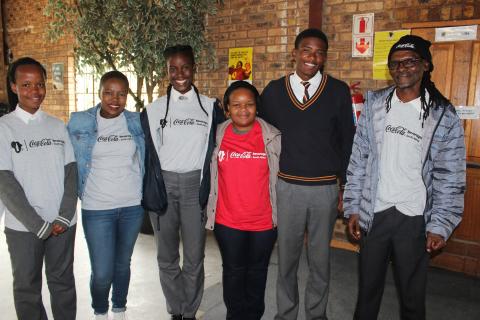
Don’t you hate it when big corporate organizations neglect their duty and promise to give back to communities they operate in? Well Coca Cola Beverages South Africa has been showing the community of Ebony Park, Rabie Ridge and Ivory Park that they give back to communities through various interventions.
On the 22nd of February, Coca-Cola Beverages South Africa together with the IkamvaYouth Ebony Park branch launched a Soul Ambassadors network for CCBSA employees and participated in the Ebony Park Mentorship day. The Soul Ambassadors are a network of CCBSA employees coming together for a good cause. Soul Ambassadors are CCBSA employees who are passionate about the community and give of their own time to deliver positive change in the communities where we operate. CCBSA supports these individuals by providing them with extra time outside of the one day community leave given to all employees to execute this work as well as funding to deliver the plan.
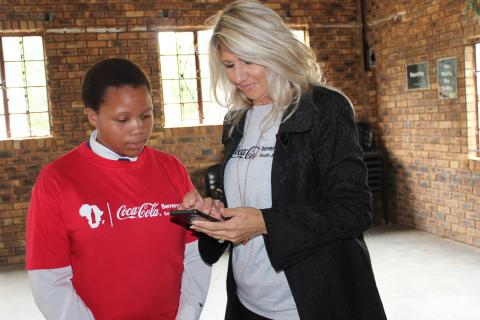
The idea is to offer CCBSA employees a chance to change someone’s life through mentorship; by helping learners / scholars move from their current state to their desired state. Learners from different schools around Midrand and Tembisa who are part of the IkamvaYouth family came in numbers to celebrate the day and also be part of the mentorship program together with CCBSA Soul Ambassadors. During the launch, the Ebony Park branch Grade 11 learners were all paired up with mentors from the CCBSA Soul Ambassadors and signed the IkamvaYouth Mentor-Mentee agreement.
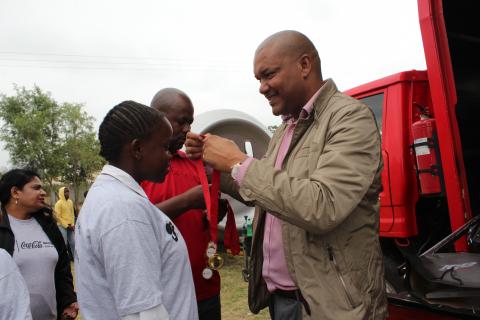
The IkamvaYouth mentorship program enables learners to access post-school opportunities. Although the career guidance workshops increase learners’ awareness of post-school opportunities and ways to access them, IkamvaYouth learners also need one-on-one support from a mentor to help them make the transition from secondary to tertiary education. The mentoring programme ensures that every Ikamvanite accesses tertiary education and/or employment once they matriculate. Secondary objectives of the programme include developing communication skills, self-knowledge and self-esteem.
Ikamvanites who participate in the mentoring program get the following benefits:
-
Increase in the mentee’s self-confidence
-
Helps the mentee learn to take better control of his or her career
-
Teaches the mentee how to speak up and be heard
-
Educates the mentee on how to accept feedback in important areas, such as communications, technical abilities, change management, and leadership skills
-
Improves the mentees interpersonal relationship skills
-
Provides an important networking contact for the mentee
This mentor-mentee relationship also enables the CCBSA Soul Ambassadors to:
-
“Give back” — to the organisation, the community and the mentee
-
Reminds the mentor how to listen actively rather than passively
-
Encourages the mentor to share knowledge and help shape the future of our youth
-
Strengthens the mentor’s interpersonal relationship skills and perceptions of the various problems facing our country’s youth and education system
-
Teaches the mentor about other areas/departments within the organisation
-
Helps re-energize the mentor’s career
Ikamvanites had this to say;
“We all need that one person who can share knowledge with you and guide through your difficult time and also be there as a thinking partner”- Adele Kayitare
“It’s a good opportunity for me to know more about Coca-Cola as it is one of the biggest organisations in South Africa. Having someone from Coca-Cola to mentor me is a blessing and I’m looking forward to the relationship” Tsolofelo Moeletsi
As Ikamvanites take a journey to success, CCBSA Soul Ambassadors will be right there with them to ensure that they reach their desired outcome.
Their Future is in their hands.
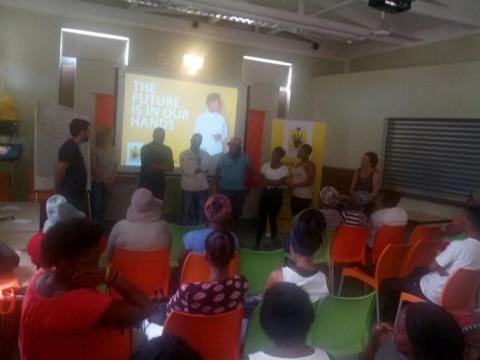
On Saturday the 28th of January 2017 the IkamvaYouth Masiphumelele branch held an Open Day. The purpose of this event was to welcome all Masiphumelele branch Ikamvanites and explain more about the programme to new parents and learners. The event was attended by almost 100 people made up of mostly learners, volunteers, parents, Library staff and IY staff.
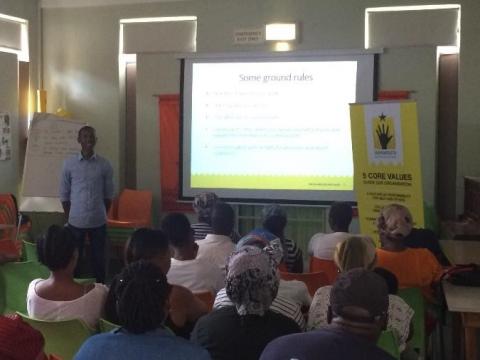
After an energetic round of question-based games which were about the importance of being a member of IkamvaYouth, the IY Masiphumelele staff presented IkamvaYouth programmes, and the 2016 matric results.
Avile Mabhengu (Alumni)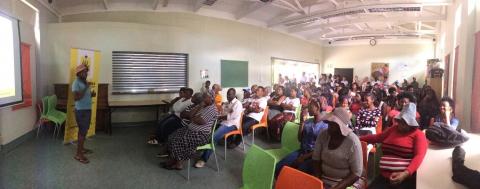
Avile Mabhengu the Masiphumelele branch alumni shared his experience at Ikamva Youth and also some words of motivation for all the learners especially the 2017 matric cohort, ”focus on your studies and make sure to use any available tools within the IY programme that will help you excel in your studies” Avile’s advice to the learners. Avile completed B.tech in Environmental Management at CPUT in November 2016 and currently Interning for City of Cape Town.
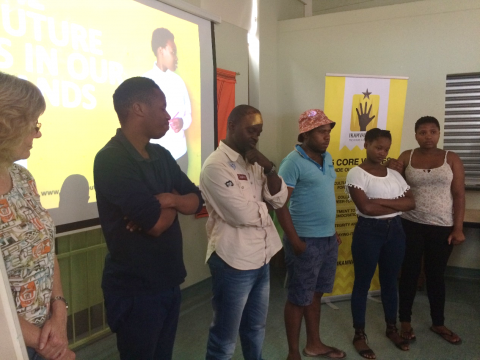
At the end of the event all the Masiphumelele volunteers came to the front and gave a brief introduction of themselves to all parents. To close the programme the Western Cape District Manager, Simone Peinke, gave a word of thanks to everyone who attended.
IkamvaYouth Masiphumelele Volunteers
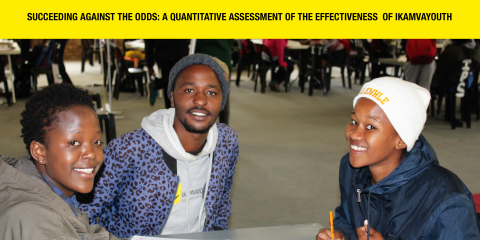
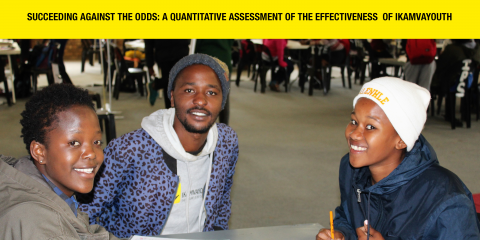
The Western Cape Government hosted the After-School Game Changer’s symposium on the 16th and 17th of February. The two days were packed with interesting speakers who work in different parts of the education and after-school sector. IkamvaYouth was fortunate to secure a spot at the end of the symposium to launch the findings of a quantitative assessment of the effectiveness of our programme. The assessment was conducted in 2016 by Servaas van der Berg and Lewis McLean, economists from Stellenbosch University.
In 2012, Prof van der Berg and Dr Nic Spaull produced Against the Odds, a largely qualitative study of IkamvaYouth, which provided a range of very useful insights, for example, into learners’ socio-economic situations, their performance in Maths and Science compared with the feeder schools, and the challenges they face at tertiary institutions. However, a major limitation of this study was the lack of realistic comparator groups that could serve as counterfactuals. A big challenge was finding an appropriate benchmark against which to measure the ikamvanites’ achievement. How do we know that their great results are due to IkamvaYouth, and not due to their own motivation and achievement which would have led them to perform well anyway, without being a part of IkamvaYouth?
We were thrilled to have Prof van der Berg return in 2016, together with Lewis McLean, to tackle this challenge and assess IkamvaYouth’s impact with a more rigorous approach. In Succeeding Against the Odds, the researchers have managed to control for learners’ prior performance (and thus for factors such as pre-programme motivation and ability), by matching learners with a comparison group of learners who were not part of IkamvaYouth, but achieved the same results in the grade 9 systemic assessments. They could then compare ikamvanites’ matric exam performance with this group of learners, as well as with the results of the feeder schools (in quintiles 1-3), and with quintile 5 schools.
The researchers presented their findings by taking the audience through this presentation, and demystifying the various graphs and statistics. The graphs depicting the distribution of scores for various groups of learners are especially compelling. As background for viewing these distributions, it’s helpful to have a look at Nic Spaull’s article about school inequality in South Africa, where he shows that we essentially have two public education systems operating in parallel; the distribution of scores for learners in the lower quintiles (poorest) schools, compared with those in quintile 5 (most privileged) are markedly distinct from one another. In Succeeding Against the Odds, van der Berg and McLean show that Ikamvanites’s scores bridge this gap, and, in the case of Life Sciences, even meet the distribution of quintile 5 schools.
Andrew Barret, from Olico, said that “what is especially noteworthy about this study is not just that it shows the clear impact of IkamvaYouth, but that it in all likelihood underestimates this impact. As impressive and significant as these results are, the reality is probably even better,” as the researchers included a host of control variables.
As part of the lead up to the presentation, we heard from Yanga Totyi who is the branch coordinator at our Atlantis branch, as well as Ntebaleng Morake an alumna from the Ebony Park who completed matric in 2012. IkamvaYouth Atlantis opened in June 2016 and Yanga spoke about the challenges and triumphs they have had so far. Ntebaleng Morake is a UCT graduate with an honours degree in Gender and Transformation. Ntebaleng accredits her exposure to different fields of study outside of the conventional to her time at IkamvaYouth. Through the programme she was able to meet young, black men and women who were studying and working in different fields and the poverty induced veil of ignorance was lifted.
After the presentation, Dr van der Berg mentioned that the 2012 evaluation had made two recommendations: (i) The alumni in tertiary are struggling and need additional support, and (ii) the researchers cautioned against fast organisational growth, as they felt that the dilution of the organisation’s enthusiastic leadership across a much bigger organisation may lead to the programme losing some its attractiveness to students. He said he was very glad that the organisation had heeded his first recommendation (by establishing the alumni department), and not the second (IkamvaYouth is now operating in 16 townships; a relatively quick expansion from the 5 sites in operation in 2012). When asked for his opinion on what it is that makes the programme effective, Dr van der Berg said he suspects that there is something in the model which makes motivation contagious. He advised us to look into research around Nudge theory, which we will do, as we continue to understand just what it is that makes the ikamvanites so awesome.
We were very encouraged by the participation from other practitioners in the field, who chose to spend their Friday afternoon with us engaging with statistics. Some attendees took to the Twittersphere during the launch:




IkamvaYouth sends out loud big-up thank yous to:
-
DGMT, which got us onto this evaluation journey back in 2012
-
The Omidyar Network, which funded the 2015 evaluation
-
The Department of the Premier of the Western Cape, which accommodated us alongside the very auspicious Game-Changer symposium
-
Yanga and Ntebaleng for speaking at the launch, and grounding this research and the findings within the contextual realities of daily branch operations, and #feesmustfall activism respectively
-
Dr Servaas van der Berg, Lewis McLean and Nic Spaull from RESEP whose insights and perspectives on our work are greatly valued, especially as we know that they are all used to working with far larger datasets, for far more important entities (like the national Government!)


 Lloyd Lungu